If you ever dabbled with dynamic linking in Linux and needed to specify where the dynamic loader (ld-linux.so) should look for shared libraries, you probably used
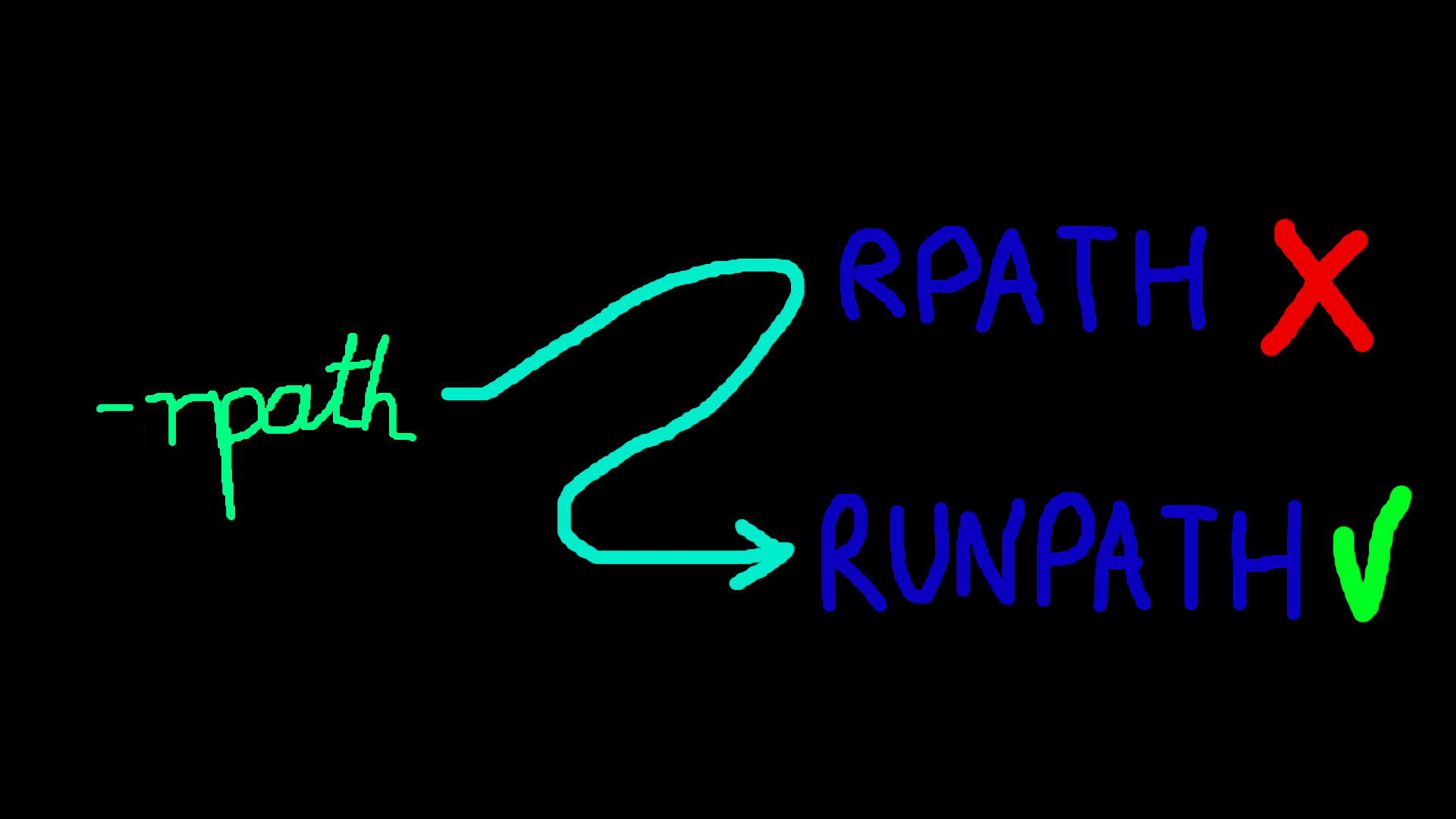
either the LD_LIBRARY_PATH environment variable or set RPATH directly in your binaries. So did I. But to my surprise it no longer works the way it used to.
How I thought it always worked
Quick recap: when the dynamic loader loads your executable and tries to resolve its dynamic dependencies, it needs to know where to look for them.
By default, it searches system-wide paths like /lib and /usr/lib. This can be overridden by setting the LD_LIBRARY_PATH environment variable, which takes precedence.
But sometimes you need to embed the path to shared libraries inside the binary, and not depend on environment settings.
Then RPATH comes to the rescue. It’s an entry in executable binary, which takes precedence over both default systems paths as well as the LD_LIBRARY_PATH environment variable.
As a linker flag, it is set using -Wl,-rpath,<PATH>.
It’s part of binary, it’s always there, it does not depend on external settings.
So the order of lookup is:
- Path written into the binary as an
RPATHentry - Path set by environment variable
LD_LIBRARY_PATH - Default paths (
/lib,/usr/lib)
But recently I tried to use -rpath and to my surprise it did not work as expected.
To be pedantic: order of looking for shared libraries is a little bit more complex than that, you can read details here: ld-linux.so - Linux manual page
Not today…
I had a simple program depending on the Qt framework which consists of many shared libraries. I had multiple versions of Qt installed on my machine, and to link against a specific one, I first used LD_LIBRARY_PATH. Everything worked. As expected.
Until I tried to override LD_LIBRARY_PATH with RPATH. I set the flag in CMake as such:
target_link_options(app PRIVATE
    "-Wl,-rpath,/home/Qt/dev"
)
But to my surprise, the old version of Qt (the one from LD_LIBRARY_PATH), was still being used. I rebuilt twice. Still the same.
I ditched the CMake and tried calling the compiler directly. It still did not give me the expected effect.
Okay, the next step is to look into the binary directly. Setting rpath flag should embed the path into the binary and I should be able to check it by tools like readelf.
Passing -d to readelf should show me information related to Dynamic linking.
$ readelf app -d | grep -E "RPATH"

<NO OUTPUT>
Nothing is there? But how can that be if I just set it?
The next step is to bet on grep not working correctly. I list entire dynamic section:
$ readelf app -d

Dynamic section at offset 0x2da0 contains 30 entries:
  Tag        Type                         Name/Value
 0x0000000000000001 (NEEDED)             (...)
+0x000000000000001d (RUNPATH)            Library runpath: [/home/Qt/dev]
 0x000000000000000c (INIT)               0x1000
 0x000000000000000d (FINI)               0x11dc
 0x0000000000000019 (INIT_ARRAY)         0x3d88
 0x000000000000001b (INIT_ARRAYSZ)       16 (bytes)
 0x000000000000001a (FINI_ARRAY)         0x3d98
 0x000000000000001c (FINI_ARRAYSZ)       8 (bytes)
 0x000000006ffffef5 (GNU_HASH)           0x3a0
 0x0000000000000005 (STRTAB)             0x500
 0x0000000000000006 (SYMTAB)             0x3c8
 0x000000000000000a (STRSZ)              403 (bytes)
 0x000000000000000b (SYMENT)             24 (bytes)
 0x0000000000000015 (DEBUG)              0x0
 0x0000000000000003 (PLTGOT)             0x4000
 0x0000000000000002 (PLTRELSZ)           96 (bytes)
 0x0000000000000014 (PLTREL)             RELA
 0x0000000000000017 (JMPREL)             0x820
 0x0000000000000007 (RELA)               0x700
 0x0000000000000008 (RELASZ)             288 (bytes)
 0x0000000000000009 (RELAENT)            24 (bytes)
 0x000000006ffffffb (FLAGS_1)            Flags: PIE
 0x000000006ffffffe (VERNEED)            0x6b0
 0x000000006fffffff (VERNEEDNUM)         2
 0x000000006ffffff0 (VERSYM)             0x694
 0x000000006ffffff9 (RELACOUNT)          4
 0x0000000000000000 (NULL)               0x0
And while I can see that there is no RPATH entry, there is a RUNPATH entry with the value I passed via the -rpath flag.
What exactly is happening?
How it actually works
What is the difference between the two?
So while the RPATH is a path where to look for shared libraries, RUNPATH is similar but less aggressive.
Two differences are:
RUNPATHhas lower priority thanLD_LIBRARY_PATHenvironment variable. This is contrary toRPATHpriority.RPATHis inherited across the dependency resolution - if your application A usesRPATHto look for dependency B, then B can use thisRPATHas well to look for its own dependencies.RUNPATHdoes not exhibit this behavior.
So the ACTUAL order of lookup is:
- Path written into binary as
RPATHentry (ifRUNPATHdoes not exist) - Path set by environment variable
LD_LIBRARY_PATH - Path written into binary as
RUNPATHentry - Default paths (
/lib,/usr/lib)
What was not working for me: first I set the LD_LIBRARY_PATH environment variable, and then I tried overriding it with RPATH.
But instead of setting RPATH I ended up with a RUNPATH entry which has lower priority than LD_LIBRARY_PATH.
As a result the shared libraries were still being loaded from LD_LIBRARY_PATH environment variable.
Case closed.
But why did the linker actually set the RUNPATH when I explicitly told it to emit RPATH using the -rpath flag?
Well, this behavior has existed for a long time.
(since 2013 actually - https://sourceware.org/pipermail/binutils/2013-January/079988.html)
If you want to emit actual RPATH you also need to set --disable-new-dtags flag.
This instructs the linker to use the “old” behavior of emitting RPATH when being asked to emit the damn RPATH.
Why did I hit this case now? This must have been the only time when I had the LD_LIBRARY_PATH environment variable set in the terminal,
from which I launched my dynamically linked application. Possibly the linker was emitting RUNPATH every single time and just did not realize it,
because there was not a LD_LIBRARY_PATH set to override it.
Well, the lesson learnt.
Extra
Both RPATH and RUNPATH can take a special token - $ORIGIN , which is resolved at runtime to the directory containing the executable.
This is useful when deploying applications with shared dependencies as you can set RUNPATH to $ORIGIN/lib and copy the dependencies along.
It also makes the program relocatable, as long as it is moved alongside its shared dependencies.
This approach is commonly used in bundled application distributions, such as the Qt framework.